

The Erasmus Mundus PlantHealth master’s programme is taking applications for its 2027 intake, and the deadline is December 31, 2026. Students who win the Erasmus Mundus scholarship get their tuition covered and €1,400 every month for up to 24 months.
It’s a two-year master’s degree in Europe, in plant health and crop protection. The call opened on October 1, so from today (October 12) you have about 11 weeks left. Only this first call gives scholarships.
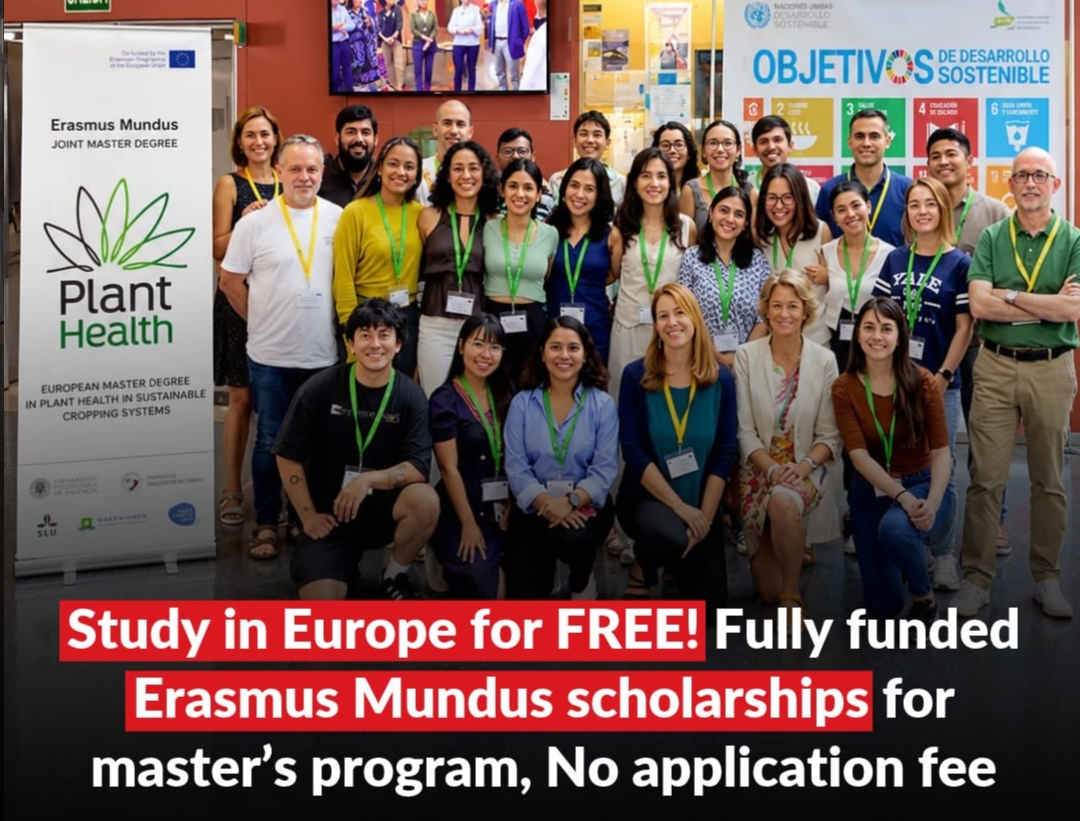
About the Erasmus Mundus PlantHealth master’s degree
PlantHealth is the short name for the Erasmus Mundus Master Degree in Plant Health in Sustainable Cropping Systems. You learn how to keep crops healthy and deal with pests and diseases, with sustainable farming in mind.
Erasmus Mundus means the European Union pays for the programme and several universities run it together. So you don’t stay in one school. You start in one country, move to another for your second year, and finish with a double diploma.

Five universities are in it: Universitat Politècnica de València (Spain), Università di Padova (Italy), University of Göttingen (Germany), AgroParisTech and L’Institut Agro (both France). Each intake takes up to 30 students from all over the world. The programme itself says the process is very selective.
Important dates for the Erasmus Mundus PlantHealth scholarship 2027
| What | Date |
|---|---|
| First call opened | October 1, 2026 |
| Online application closes | Before January 1, 2027, 00:00 (CET) |
| Results of the first call | End of February 2027 |
| Second round (self-funded only) | May 20 to June 15, 2027 |
Only people who apply in the first call can win an Erasmus Mundus scholarship or a PlantHealth Consortium scholarship. The second round has no scholarships at all.
Nigeria time is the same as CET during winter. So the deadline hits the minute December 31 ends. Don’t wait for the last day, sha.
Benefits of the PlantHealth Erasmus Mundus scholarship
The Erasmus Mundus scholarship gives you:
- All your tuition and participation costs, full insurance, and the compulsory academic costs.
- €1,400 per month for up to 24 months, which adds up to €33,600 over the two years.
- A double diploma, with classes in at least two countries.
That €1,400 isn’t extra money on top of other allowances. The programme says it is meant to cover your travel, visa, settling in and living costs. Plan your money around that.

There’s also a smaller one called the PlantHealth Consortium scholarship. It is only a fee waiver, given to strong applicants if funds are available. It doesn’t pay for travel, accommodation or living. The good part is you can combine it with other scholarships.
And if you end up self-funded? The fees page still shows the 2026 intake figure, which was €5,500 per year for non-EU students. The 2027 fee isn’t posted yet, so check before you plan anything around it.
Who is eligible to apply for the Erasmus Mundus PlantHealth scholarship 2027
- A bachelor’s degree of 180 ECTS in Agronomy, Agricultural Sciences or a related field.
- On top of that, at least 4 ECTS in Plant Health or Crop Protection, or something equivalent.
- Proof of B2 English, unless English is your native language.
- Still in your final year? You can apply, but you must finish the degree before the programme starts at the end of August, or your selection is cancelled.
- If you ever got an Erasmus Mundus Joint Masters scholarship before, you can’t apply for this one. And you can’t hold another EU grant at the same time.
The 180 ECTS line is the one Nigerian applicants will ask about, because most Nigerian bachelor’s degrees run four or five years. The official page only says 180 ECTS usually equals a 3-year bachelor’s. It doesn’t say how a Nigerian degree is counted. It does say they check your transcript to see that you have the science background.
So open your own transcript. Look for courses like plant pathology, entomology, crop protection or pest management. Not sure it will count? Send a short email to planthealth@upv.es before the deadline and ask.
No agriculture degree at all? The programme says it mostly picks people from agronomy and related fields, but it still reads your transcript before deciding.

Documents you need for the PlantHealth application
Everything is uploaded in the online form. Nothing is accepted by post or email.
- Your CV. Any format works, and Europass is the one they recommend.
- Degree certificate with the official seal. Final-year students upload a letter from their school saying they’re in the final year (with the expected graduation date), or a provisional certificate if they have one.
- The full transcript of records for each degree you have.
- Proof of English, unless it’s your first language. They accept IELTS, TOEFL iBT, Cambridge, Trinity ISE, ESOL, Oxford Test of English and PTE. A letter from your university saying your degree was fully taught in English also works, but a real certificate makes your application stronger.
- Two recommendation letters, written on the official PlantHealth template that you download inside the portal. Each letter needs the school or company letterhead (name, logo, address), the referee’s work email and phone number, their signature, and the official stamp.
- A declaration on honour. You’ll find the template in the Documents Upload section.
- Anything else that helps your case, like publications. If you’re applying under the vulnerable group, add proof such as income certificates, tax papers or bank statements, with a certified English translation.
You don’t need to legalise or apostille your documents at this stage. Proof of residence is only asked from people who get selected.
Incomplete applications are not considered, and you can’t edit an application after you submit it.
How to apply for the Erasmus Mundus PlantHealth scholarship 2027
- Go to the PlantHealth online application form and create an account with a username, password and email address.
- Fill the form in English. All your uploaded documents must be in English too, translations included.
- Choose the universities you’d like to attend. This is your preferred mobility scheme. The PlantHealth Board decides your final route, so you may not get your first choice.
- Type your motivation in the box. The limit is 1,000 characters, spaces included.
- Upload your documents and submit.
Made a mistake after submitting? Create a new account and apply again. The system reads only your most recent application. As for the confirmation email, the FAQ says it sometimes doesn’t arrive. No email doesn’t mean the form failed.
For questions, write to planthealth@upv.es.
How PlantHealth picks students for the scholarship
| What is scored | Weight |
|---|---|
| Academic record and merits | 60% |
| Reference letters | 20% |
| Personal motivation | 20% |
Your transcript carries most of the weight. Your two referees and your 1,000 characters of motivation share the other 40%, so don’t rush them.
Eighty percent of the scholarships go to the best-scored candidates, spread across world regions when the quality is there. The other 20% go to high-scoring applicants who are more vulnerable, like refugees, people from disadvantaged backgrounds, people with special needs or low income. That share is also used to balance gender. The programme says it has an equal opportunities policy for women. It doesn’t say how many slots go to any one region.
Where you will study and what the two years look like
In the first year (M1) everybody studies the same core subjects: crop sciences, crop protection, population biology, molecular biology and statistics. You pick Valencia or Padova for this year, and it’s all in English.
In the second year (M2) you move to a university in a different country from your first one and specialise. The last semester is your master’s thesis.
| Second-year university | What you specialise in |
|---|---|
| Universitat Politècnica de València | Mediterranean crops in orchards and greenhouses |
| Università di Padova | Temperate fruit crops, ornamental plants and landscape |
| University of Göttingen | Temperate crops, arable crops and crops for energy |
| L’Institut Agro and AgroParisTech | Tropical horticulture and temperate vegetable crops |
Second-year classes are in English everywhere except the French universities, where teaching is in French. If you go to France, the programme gives you French classes in year one and a free two-month intensive French course before year two. It still advises you to start learning French at home.
Mistakes that can cost you a place in the PlantHealth application
- A Duolingo result, TOEIC, a free online course certificate or a letter from a language school as your English proof. None of these are accepted.
- PDFs bigger than 1MB. Each box takes one PDF only, so merge your pages into one file and shrink it first.
- Reference letters in your referee’s own format instead of the official template. Or with no stamp.
- Rushing the submit button. An error found afterwards can’t be fixed.
Read common mistakes that make Nigerian students lose scholarship slots before you submit, and use how to write a scholarship personal statement people will read for the motivation box.
Want more options while you prepare? See 8 postgraduate scholarships Nigerian students can apply for to study a masters or PhD abroad, or fully funded scholarships Nigerian students can apply for without IELTS. More are on the scholarships page.


