

The Center for Comprehensive Promotion of Reproductive Health (CCPRH) has opened recruitment for Data Collectors in five states: Borno, Adamawa, Yobe, Sokoto and Zamfara. The deadline is Tuesday, October 20, 2026. It is a contract job, and the fieldwork should run for about 8 to 15 days after training.
Applications are online on the CCPRH website. No fee at any stage.
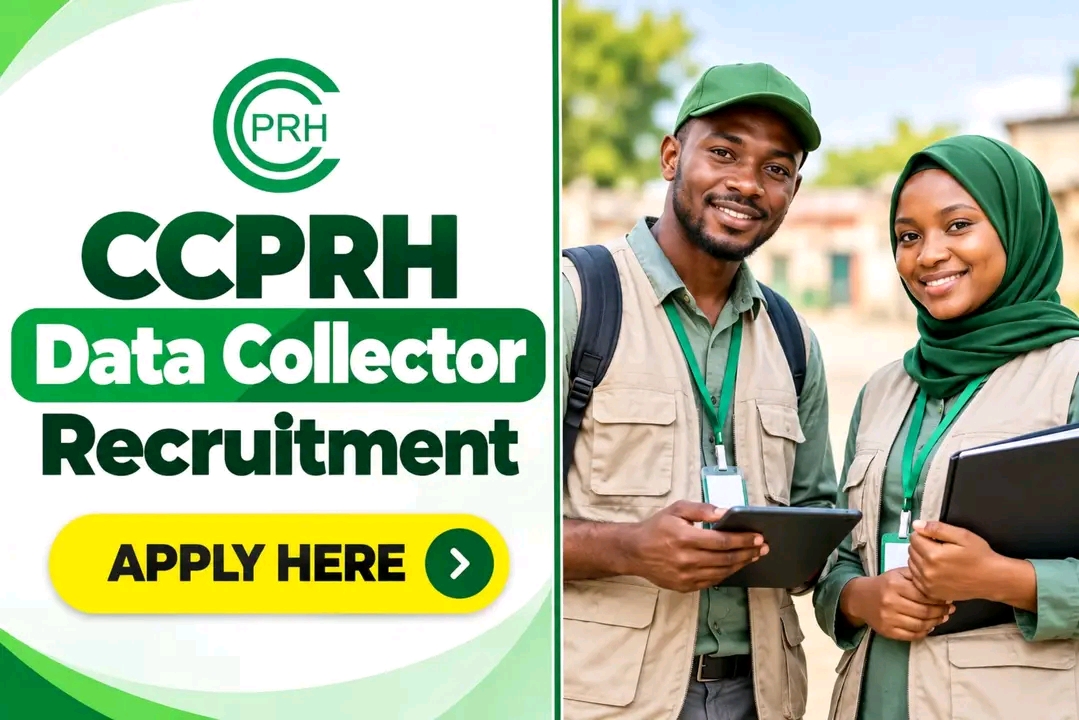
Quick facts about the CCPRH Data Collector recruitment
| Detail | Information |
|---|---|
| Organisation | Center for Comprehensive Promotion of Reproductive Health (CCPRH) |
| Position | Data Collector |
| Job type | Contract |
| States | Borno, Adamawa, Yobe, Sokoto, Zamfara |
| Posted on | October 13, 2026 |
| Deadline | Tuesday, October 20, 2026 |
| Fieldwork period | About 8 to 15 days, after the compulsory training |
| Application fee | None |
About this CCPRH Data Collector job
CCPRH is a health organisation. Its office is at UCH, Ibadan, but this job is not in Ibadan. It is for a humanitarian assessment in the five northern states above.
What is the assessment about? It looks at the needs, risks and services for sexual and reproductive health, and for gender-based violence (GBV). GBV simply means violence done to a person because of their gender.

A data collector goes into the community with a phone or tablet, asks people the questions on the survey, and records the answers correctly. But the work is not only house-to-house questions. The assessment has several parts:
- household interviews
- health facility and GBV service checks
- focus group discussions (a small group of people talking together on one topic)
- key informant interviews (one person who knows the community well, like a health worker)
- market and cash assistance checks
- environmental risk screening
You may be asked to do some of these, not all, depending on what you are assigned.
Where the CCPRH data collectors will work
You must pick one state when you apply. If you get through, you can be sent to any of the LGAs listed for that state.
| State | LGAs |
|---|---|
| Borno | Gwoza, Mafa, Bama |
| Adamawa | Michika, Madagali, Mubi South |
| Yobe | Damaturu, Gujba, Geidam |
| Sokoto | Sabon Birni, Isa, Goronyo |
| Zamfara | Gummi, Anka, Kaura Namoda |
CCPRH says it may give preference to people who live in the state, have worked there before, or know the local languages and the area. So choose the state you actually know. Don’t pick one just because you think there will be fewer applicants.
Requirements to apply for the CCPRH Data Collector job
You must have all of these:

- At least an HND, a bachelor’s degree or an equivalent qualification. The courses listed are public health, social sciences, health sciences, nursing, midwifery, demography, sociology, psychology, statistics, development studies, or another relevant field.
- Experience in field data collection, either quantitative (numbers and surveys) or qualitative (interviews and group talks).
- You have used a smartphone or tablet to collect data before.
- Good communication and people skills.
- You can work in communities hit by humanitarian crisis, displacement or insecurity.
- You are free for the whole training and fieldwork period. Not part of it, all of it.
- You are willing and able to travel within the LGAs of the state you choose.
Read the line about insecurity again before you apply. The communities are in places affected by crisis. Be sure you are fine with that.
Things that will count in your favour
None of these is compulsory, but they help your application:
- Past use of KoboToolbox, ODK, SurveyCTO or a similar tool
- Work on sexual and reproductive health, maternal health, GBV, protection or humanitarian assessments
- Experience running focus group discussions or key informant interviews
- Time spent working with internally displaced persons (IDPs), returnees or host communities
- You understand informed consent, privacy and safeguarding
- You know the state’s geography and its humanitarian situation
- You speak the local languages of the state or LGAs, for example Hausa or Kanuri where they apply
CCPRH also says female applicants, and people who have shown they can work well with women, adolescents and other vulnerable groups, are strongly encouraged to apply.
What a CCPRH data collector will do on the job
The official call lists the duties. In plain words:
- Attend the compulsory training, tool reviews, role plays and field pretesting.
- Pick clusters, households and respondents the way CCPRH approves, not the way you find easiest.
- Interview adult women and adolescent girls using electronic questionnaires.
- Focus group discussions with women, girls, men and boys, when you are assigned to support or run them.
- Consent comes first, and for adolescents there are approved assent steps too.
- Respondents’ information stays private, and every respondent gets respect.
- Enter data on KoboToolbox, ODK or whichever platform CCPRH approves.
- A daily team debrief, plus quick replies when someone queries your data.
- Take care of the phones, tablets and forms you are given.
Training is not a job offer. Completing training does not guarantee you will be deployed. CCPRH will decide after training and pretesting, based on how well you handle the tools, the electronic platform, and the ethics and safeguarding rules.

How to apply for the CCPRH Data Collector recruitment
- Go to the CCPRH website at ccprh.org.ng.
- Open the Career page from the menu.
- Click Call for Applications: Data Collectors.
- Fill the form at the bottom of that page. It asks for your full name, email, phone number and a short bio, then you upload your CV. The CV must be .pdf, .doc or .docx.
- Submit before October 20, 2026.
Direct link to the page: CCPRH Call for Applications: Data Collectors
The cover letter is where people get stuck. The call says to prepare one that states the position and your preferred state. The online form, though, has no cover letter box. It has a Bio box. So put that information there in two or three lines, something like “Applying for Data Collector. Preferred state: Zamfara.” Want to add more? Put it in your CV, but the CV must not go beyond three pages.
Your CV should show:
- your qualifications
- field work you have done
- the languages you speak
- the electronic data collection tools you have used
Never used KoboToolbox or ODK? Learn the basics on your own before training starts, since the job runs on them. Our post on free online courses that can make your CV stronger may also help you build up your profile.
Things to know before you submit
- Never pay anybody. CCPRH says no payment is needed at any stage. That includes recruitment, training and deployment. If someone asks you for money in the name of this job, it’s a scam.
- Only shortlisted applicants will be contacted. Your qualifications and past field experience may be checked.
- The call does not say how much data collectors will be paid. If you are shortlisted, ask about pay, transport and feeding before you commit.
- The Career page also lists a call for State Supervisors. That is a different job. Make sure you open the Data Collector one.
- Questions? CCPRH lists support@ccprh.org.ng and +234 9010374759 on its website.
More jobs you can apply for
Looking for other openings? Our job recruitment page has the latest ones. We also covered the OYSIEC ad hoc staff recruitment for the December 29 local government election, which is another short-term job. And if you are still working on your online profile, read LinkedIn and Indeed for Nigerian job seekers, which one gets you hired faster.



Please I would to know more about this job opportunity kindly provide me with more Information on how to apply thank you
Please read the article carefully